
Hildegard of Bingen, stained glass detail, Rochuskapelle.
God, what am I doing? It’s a random Saturday in January, it’s pouring rain, and I am perpetually without an umbrella. I’m running through midtown eating one of those tuna-salad-in-a-can “snacks” from Duane Reade and booking it to John Jay College because I drove down to Long Island from Boston this morning to say hi to my mom before getting the train at Ronkonkoma and, as always, miscalculated just how long that ride actually is. Anyway, I’m running, I’m eating this tuna salad that’s actually kinda delicious, my tall friend John is looming nearby and we’re laughing about the shit we do for art. We’re on our way to see the NYC premiere run of Sarah Kirkland Snider’s Hildegard at Prototype Festival. I am a huge fan of Snider. Penelope is on my list and John’s too (we’re in an indie classical electric guitar-voice duo called Saint Boneface). Her music sits at that sick precipice between classical and something you could put on your friend group’s shared playlist without anyone getting too mad that you’ve included “opera” in the jam.
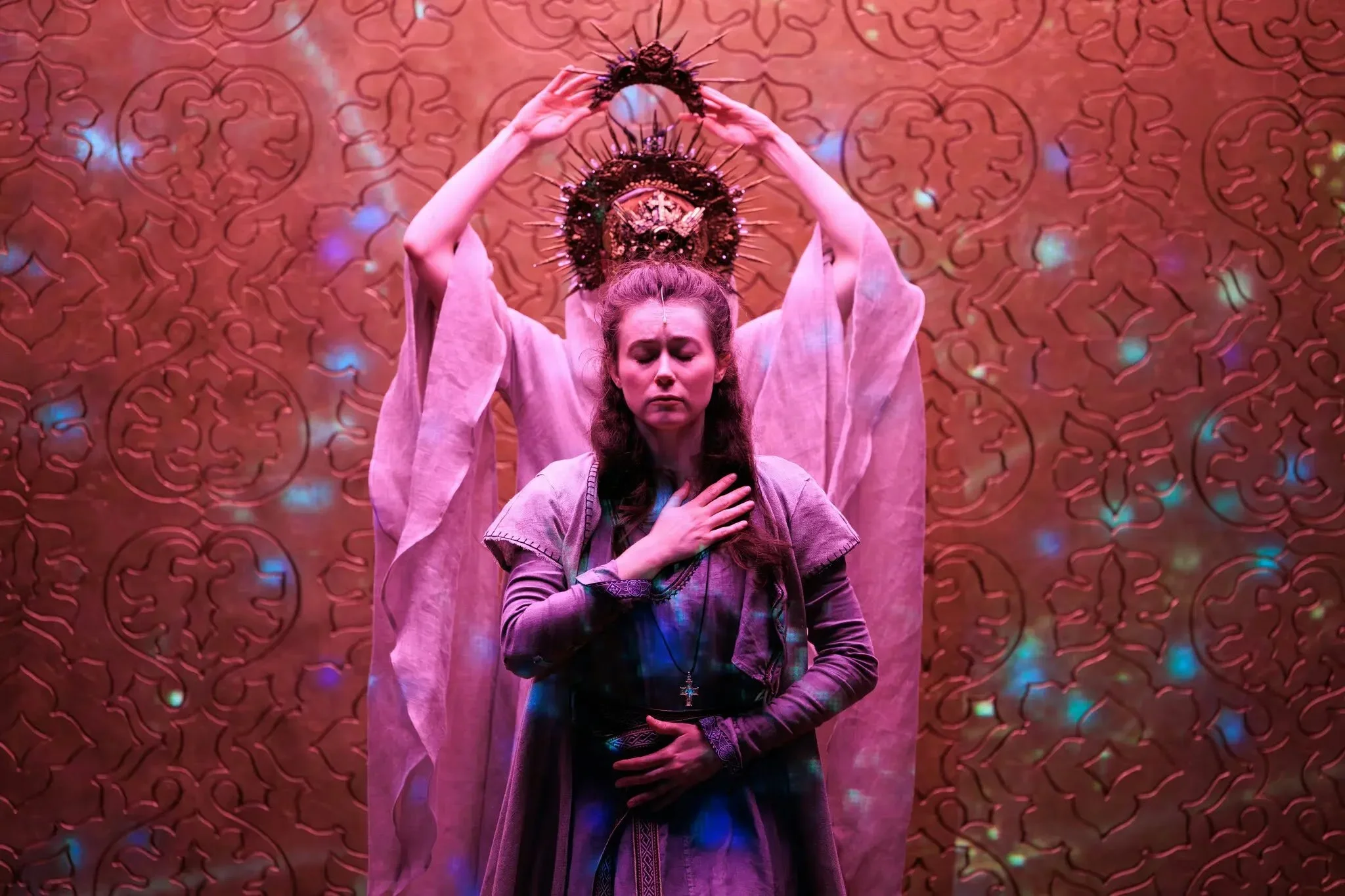
Photo by Angel Origgi. Production photos of Sarah Kirkland Snider’s Hildegard.
I don’t know about you, but I’m seeing Hildy everywhere. Her music is being performed more than I can remember in my musical life – by the NEC Chamber Singers, musicians at Trinity Copley Square, students at the Longy School of Music under the instruction of Pamela Dellal (founding member of Sequentia, an ensemble that recorded literally all of Hildegard’s vast oeuvre), Rocky Duvall, the Pandora Consort (featured in the New York Times and on Vermont Public Classical, with an album coming out), and now the ensemble of this huge, stunning opera. Hildegard’s music can be heard on television (hearing “O rubor sanguinis” in Merlin was a real delight during the first Covid lockdown), and she has several films in English and German detailing her life. I see her visions in memes (here and here especially), and have eaten an insane amount of her Cookies of Joy (she’s lowkey credited with creating the pumpkin spice blend, so if anyone dares call you basic for that, you can tell them it’s medieval medicine and that they should just let you enjoy stuff).
I think she’s in our cultural subconscious for a few reasons. Firstly, Hildy was a polymath. Within the confines of her cloistered life, she worked as a botanist, a physician, a philosopher, a poet, a composer, and a spiritual leader. It makes sense that her crossover in these fields creates a wider audience for her work. Hildegard is also a badass feminist figure (hello, creating her own abbey, being allowed to write and record her divine visions, having the first Western female composer credit, etc). She symbolizes strength and defiance in the face of oppression while still holding strong to her faith. Let’s face it: she’d be protesting with us, forging a path for bodily autonomy, encouraging girls to pursue their passions, and saying “fuck you” to the powers that be today because that’s what she was doing in the 12th century.
How, though, do we bring her to life? When music and stories are that old, even when they are as worth sharing as Hildegard’s, it can be difficult to draw people to them. I think the answer lies in movement.
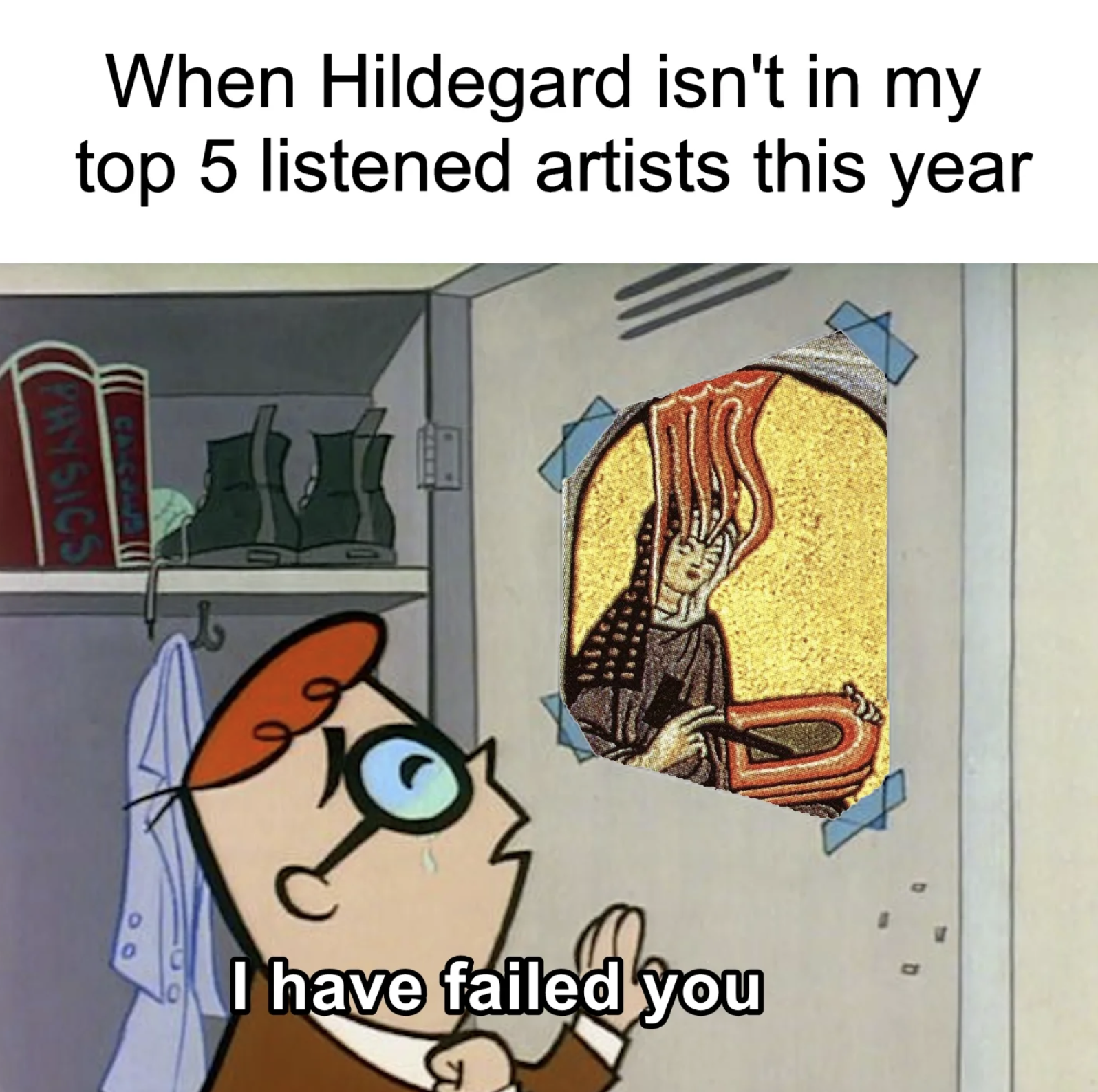
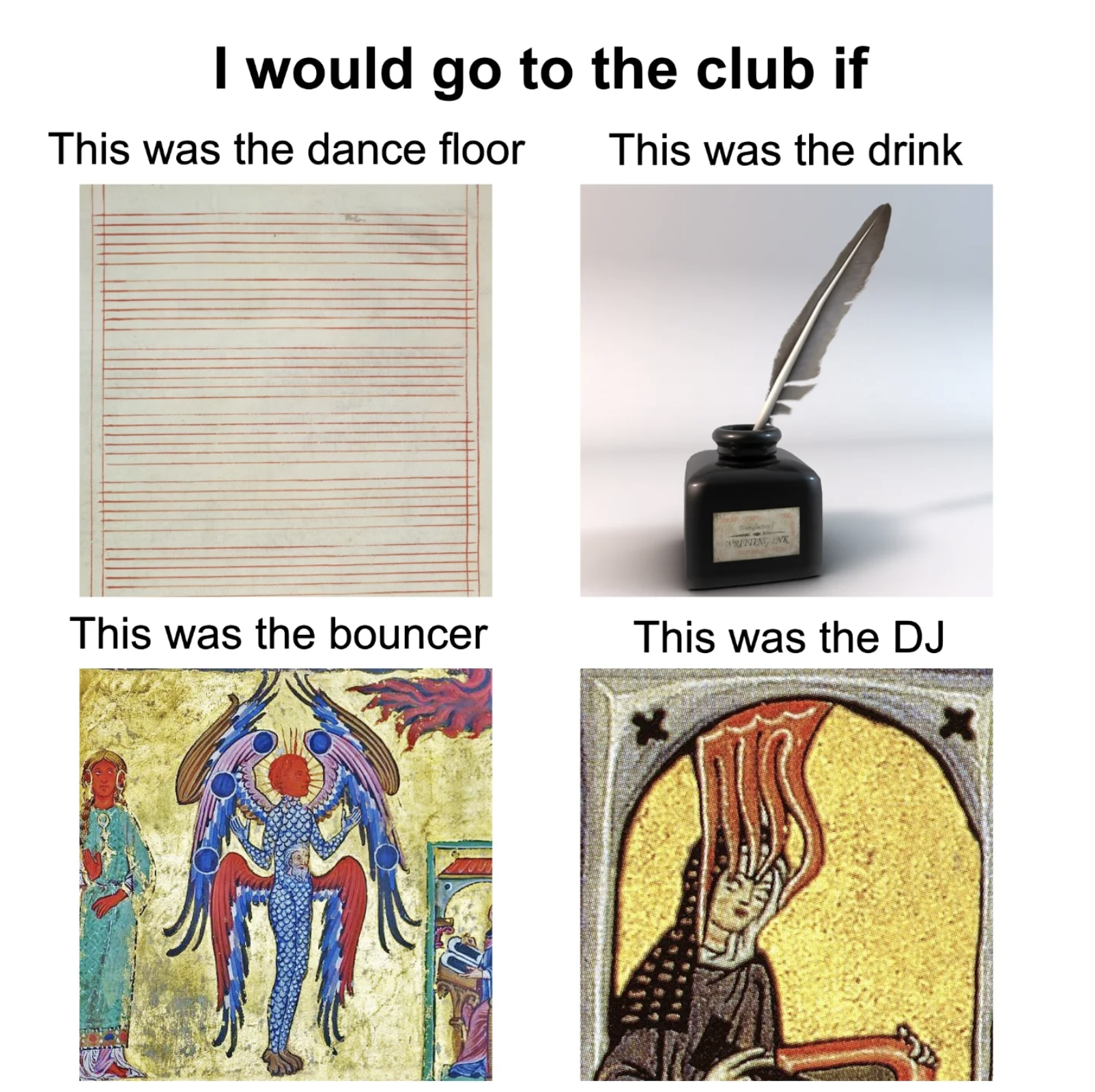
I’m part of the aforementioned ensemble, The Pandora Consort. We’re a trio of singers based in Boston and currently touring a few programs, the most popular of which is Hildegard Reanimated: Vision in Vision. We present a selection of Hildegard’s music with some of her divine visions projected behind us. Get this, though: we had them animated by visual artist Cate Duckwall, so they kind of come alive as we move through the program.
Our audiences love to see the animated visions projected in huge format while we sing her music. These visions were moving when they came to Hildegard (whether due to divine intervention or chronic migraine), so why not try to recreate what she saw to the best of our 21st century ability?
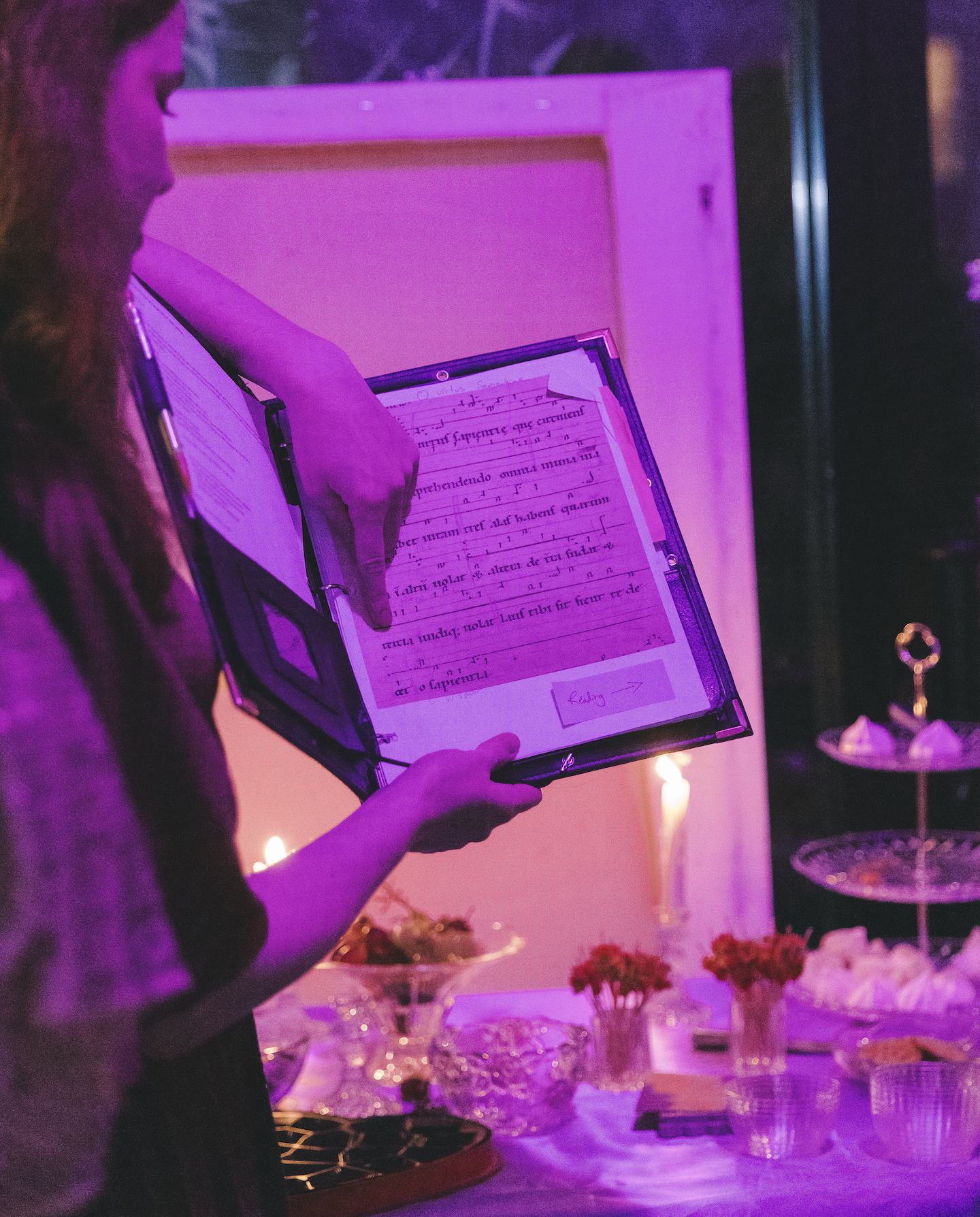
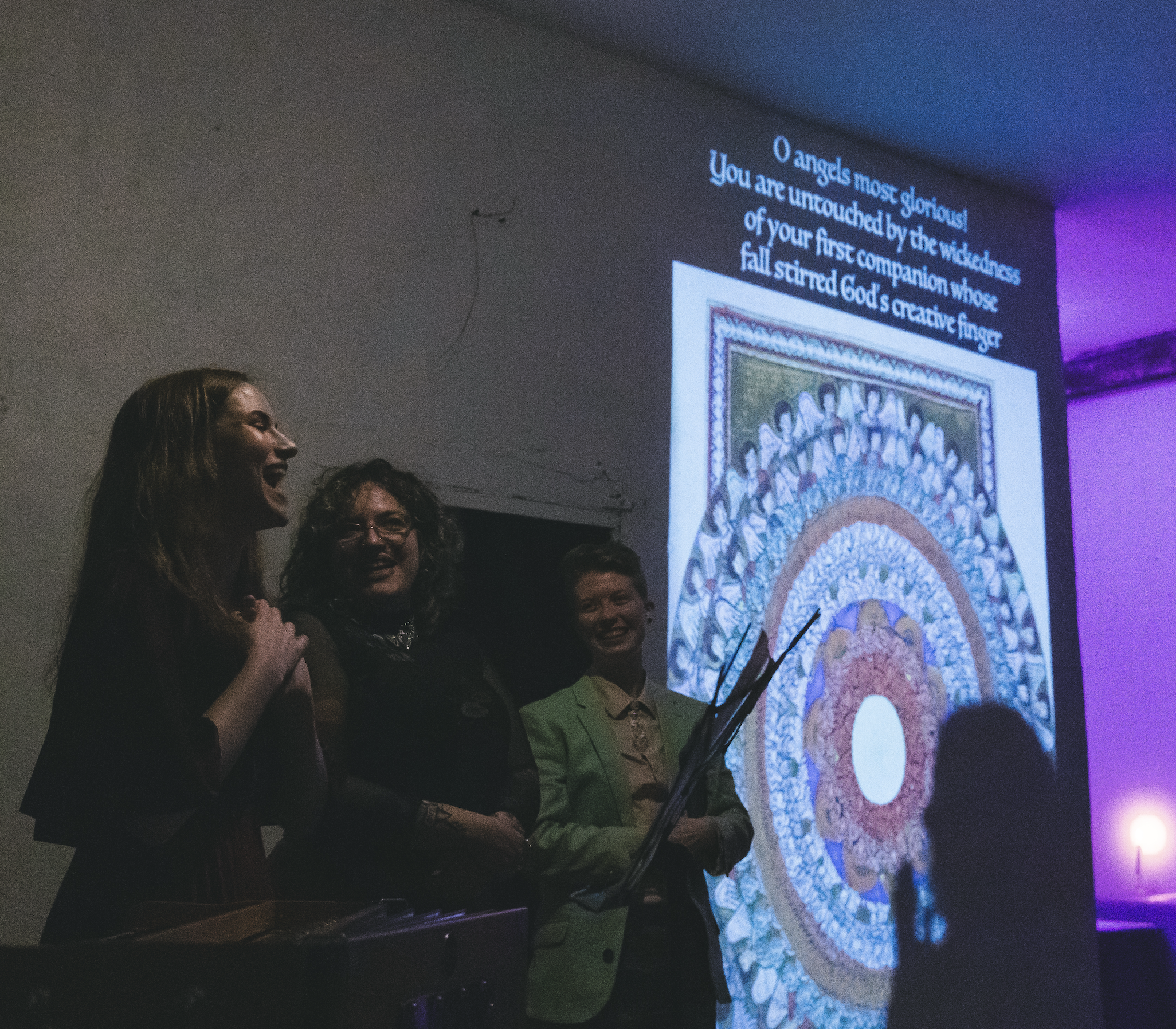
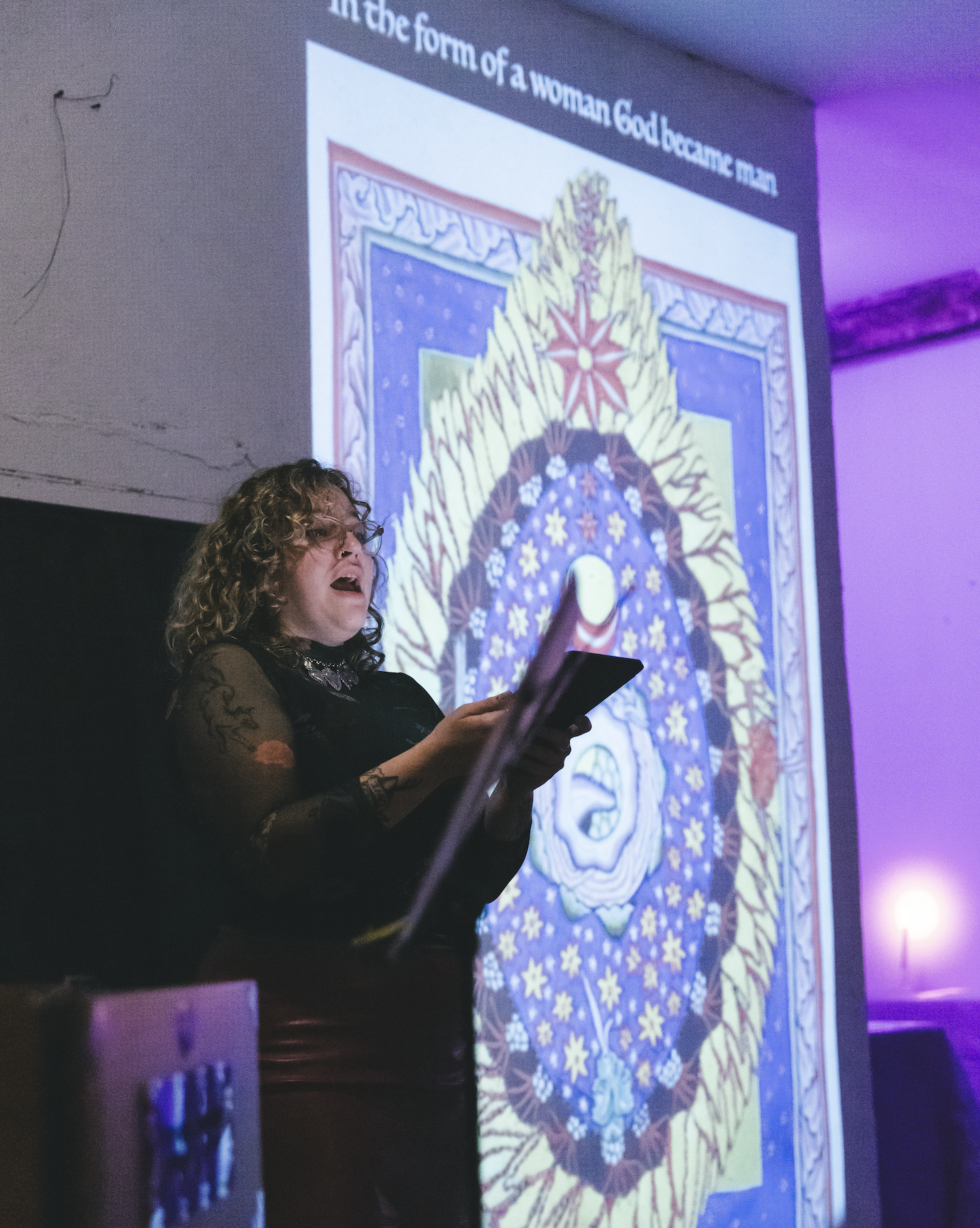
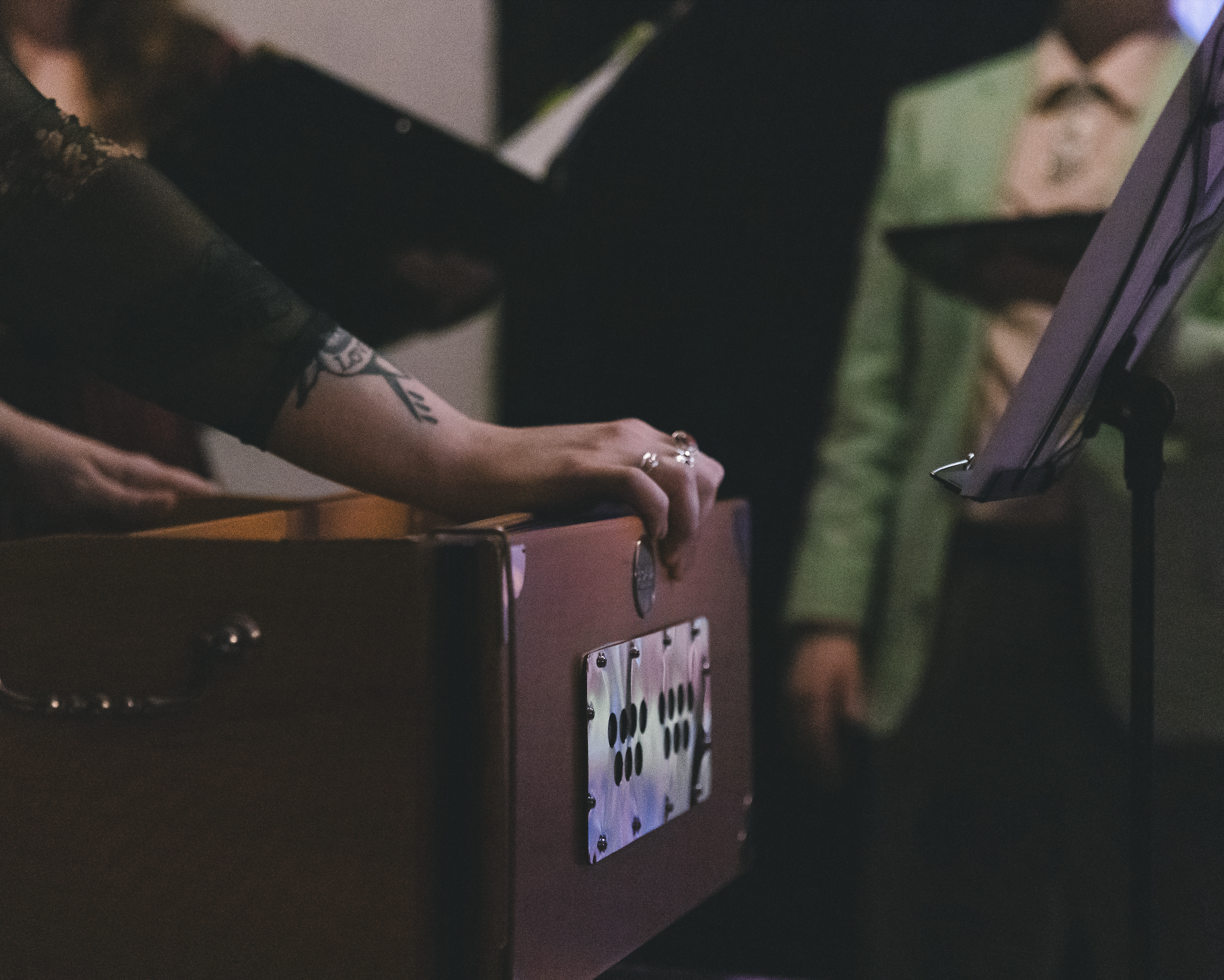
Hildegard Reanimated: Vision in Vision at Salon Avec Moi with The Pandora Consort (2025). Photos by McKenna Christine Poe.
In Sarah Kirkland Snider’s Hildegard, movement is everything. The set changes are choreographed in stunning synchronicity. Hildegard and the Faceless Woman dance in a devastating expression of the relationship between soul and body. The projections of Hildegard’s visions, redrawn to more closely fit the aesthetic of the opera, are larger than life and breathtaking as they glitter on the backdrop and the walls of the scriptorium.
This strong sense of choreography, as well as the tight orchestration and exciting Snideresque effects coming from the pit keep me engaged throughout the nearly three hour-long evening. My favorite moments are the vision scenes with the choir of angels – these are the (too-) few instances in which Hildegard’s compositions can be heard in gorgeous aleatoric echoes, with a little bit of Zorn-like contemporary vocal color from the absolutely breathtaking talents of Angels 1 and 2, Raha Mirzadegan and Blythe Gaissert, respectively. The opera draws to a close and we see vision weaving into reality, and I think about how I would be satisfied if those scenes were all of the opera.
“Let’s face it: she’d be protesting with us, forging a path for bodily autonomy, encouraging girls to pursue their passions, and saying “fuck you” to the powers that be today because that’s what she was doing in the 12th century.”
John and I leave after saying hi to eight people we know, because the music world is so tinysmall. We continue pondering over a slice of pizza with a friend. We are so curious as to why the singers were mic-ed? And did Snider take inspiration from Stravinsky in those close woodwind harmonies in that one scriptorium scene? And the plot was similar to that German movie about Hildegard and I wonder if Sarah has seen it. And man, the choreography of that opera was so damn sick. The movement really made a spectacle of it. “The movement really brought it to life,” John says.
We walk to Columbus Circle and get on the train that takes us to the train. I fall asleep to the sound of drunken college students snoring all the way back to Ronkonkoma, the remarkable final scene of Hildegard moving through my mind.
_________________________________
Writer: Gina Marie Falk
Editor-in-Chief: Karlye Whitt