
Spectrum of Desire
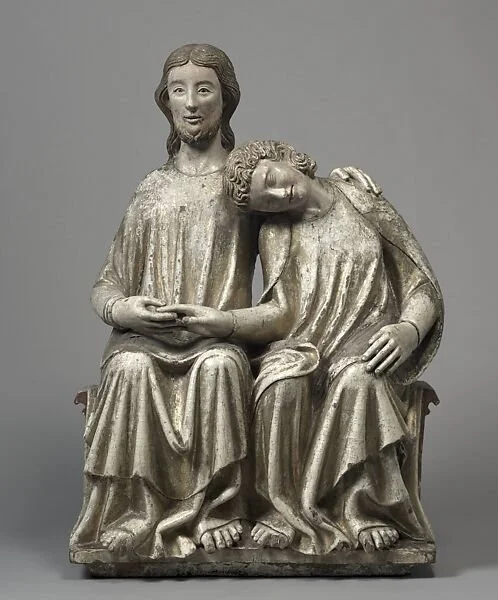
Christ and Saint John the Evangelist. Courtesy of The Metropolitan Museum of Art. https://www.metmuseum.org/art/collection/search/909312
My queerness was always sold to me as a new thing. Something that was uniquely of the 21st century–buzzfeed articles and pride parades sponsored by Clorox. The institutional opposition to queerness was something that had been naturalized, withholding tradition in a time of intense social upheaval. I was not raised deep in any institution by any means, my life took root as anyone else’s would in the American midwest during the Obama years. My identity shifted into place despite expectations. In high school, I dated my, at the time, girlfriend for 2 years. Their parents, devout Catholics, were deeply and horrifically conservative. It was my first true relationship to the institution of the Catholic Church. The institution, presented by the mother, was the only truth–and held only one way of interpretation. The past was the same as the present and queerness was the opposite of everything good and holy.
The repositioning of this rhetoric took me a while to develop into–and takes a level of care and tenderness that is often overlooked. Gender nonconformity and fluidity seep into our least expected histories, even in the medieval catholic church. In Spectrum of Desire–put on by the Met Cloisters–the exhibit relies heavily on queer theory, a framework that historically challenges the boundaries of sex, gender, and desire. The argument that Spectrum of Desire makes about desire, sex, and gender in the middle ages is rooted in the contemporary practice of queer theory in relation to religion and artistic practices. Pushing for a larger scope of understanding of not just queer history, but medieval history at large becomes the central thesis of the exhibition. Confirming that queerness is not a new trend in contemporary culture, but is a historical and anthropologic truth that dates back to the middle ages and beyond.
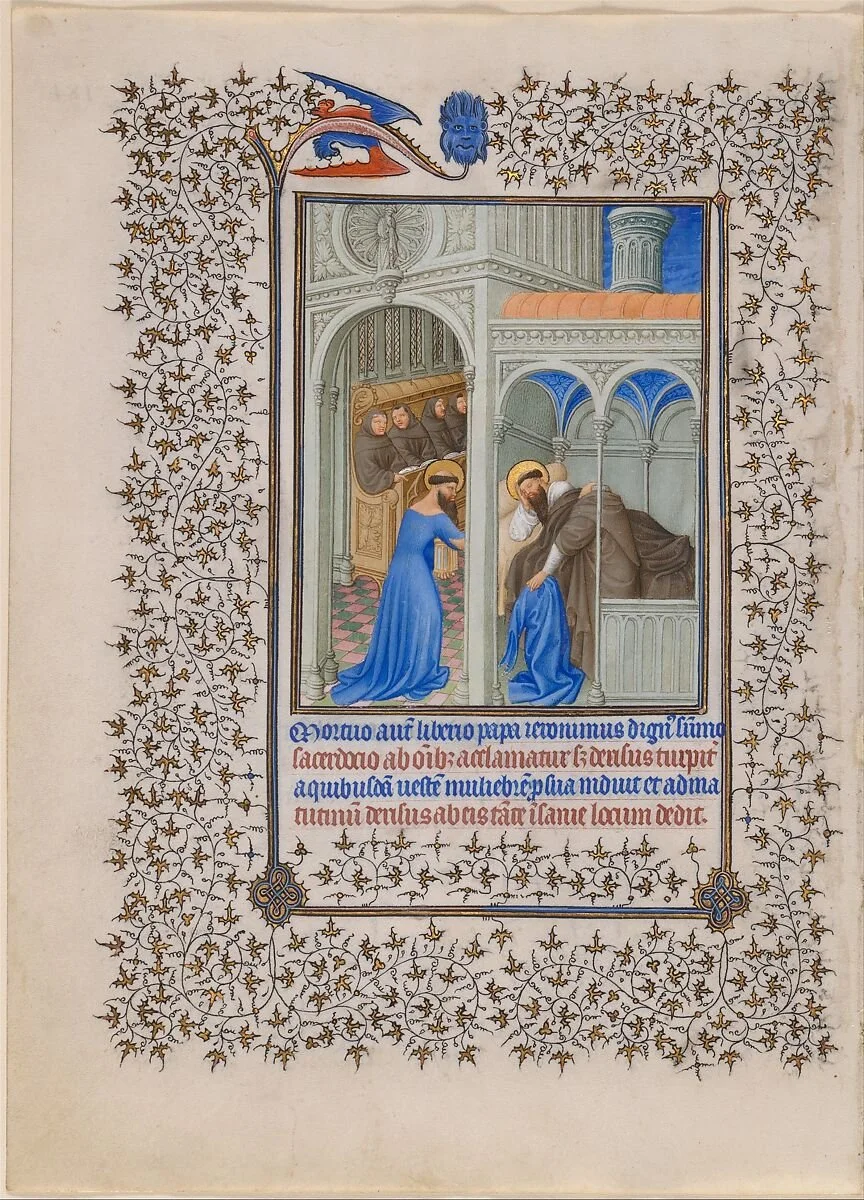
Folio 184v, Saint Jerome in a Woman's Dress. Courtesy of The Metropolitan Museum of Art. https://www.metmuseum.org/art/collection/search/470306
The gallery, tucked in a small yet central part of the cloisters, features an array of relics, religious and secular alike. The tenderness of Jesus’ relationship with the disciple John gives itself to a queer lens through curational stratigies–but does not probe too deeply into speculation. Gender play is explored through the display of The Belles Heures of Jean de Francewhich displays Saint Jerome in a Woman's Dress–soemthing often interpreted as explicit gender variance. Heterosexual sexual practice is reframed humorously through a Plate with Wife Beating Husband. The ways Spectrum of Desire has invited us to expand upon love, sex, and desire allow for an expansive view of the past–not just one defined by reactionary politics of the present.
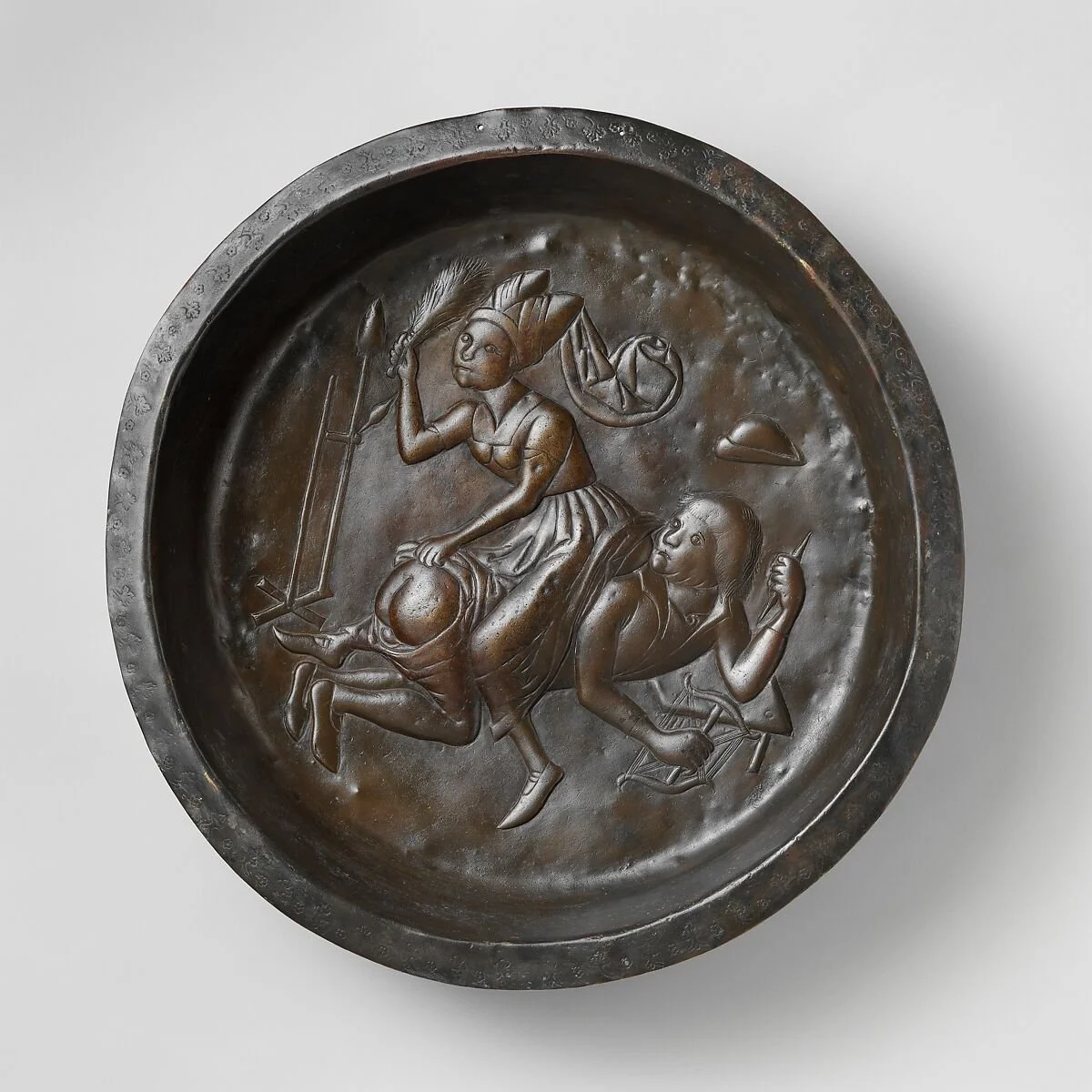
Plate with Wife Beating Husband. Courtesy of The Metropolitan Museum of Art. https://www.metmuseum.org/art/collection/search/468640
Love is defined broadly, largely and fluidly. Not everyone desires confirmation from the past–but the queer theoretical lens allows for new interpretations to be disseminated to more audiences. For an audience of outsiders, the exhibit reminds us of the humans and artisans behind the institutions, those with desires and identities that are sometimes foreign, but are often familiar. For queer Catholics, this exhibit becomes a branch of healing, connecting them to a past and a present that they may not feel as alien to. The rebuilding and reorientation of these relationships has become the central thesis of the exhibition, bringing a historical identity to light in a way that resonates with our modern existence.
Sources:
“Kris Trujillo, Queer Medievalism.” UChicago Division of the Arts & Humanities, 6 Oct. 2020, …https://www.youtube.com/watch?v=dU6-YnDOo08. Accessed 18 Dec. 2025.
Noll, Stephen. “Reclining on Christ: Saint John’s Example of Intimacy with Jesus.” Anglican …Compass, 8 June 2024, …anglicancompass.com/reclining-on-christ-saint-johns-example-of-intimacy-with-jesus/.
Ross, Nancy. “The Middle Ages, an Introduction.” Smarthistory, 8 Aug. 2015, …smarthistory.org/introduction-to-the-middle-ages/.
“Spectrum of Desire: Love, Sex, and Gender in the Middle Ages.” The Metropolitan Museum of …Art, …www.metmuseum.org/exhibitions/spectrum-of-desire-love-sex-and-gender-in-the-middle-ages…/inside-the-galleries. Accessed 18 Dec. 2025.
Writer: Jessie Miller
Editor-in-Chief: Karlye Whitt
