
Why Bad Bunny’s Performance Upset Me: When Representation Becomes a Test We’re All Failing
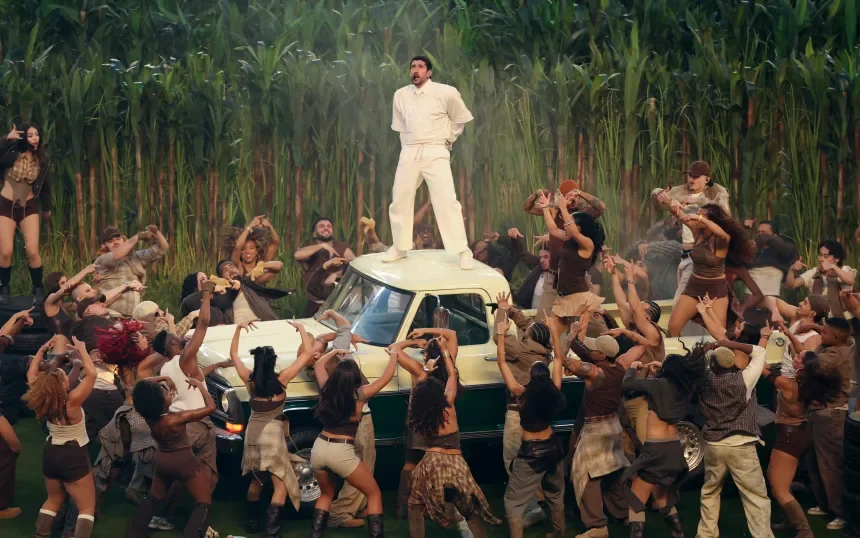
Bad Bunny performs during the Super Bowl LX halftime show. Image Source: Patrick T. Fallon/AFP/Getty Images
I didn’t even watch the halftime performance live, but I felt represented anyway.
I saw my flag. I saw sugarcane. I saw Caribbean and American cultures intersecting without apology. All I felt was love — pride, joy, celebration. And I was genuinely glad that so many people, especially those who are so often erased, felt seen on a global stage.
But what unsettled me wasn’t the performance itself, it was the reaction.
Almost immediately, the response hardened into something familiar: complaints that it was “political”, complaints that the performance wasn’t in English, declarations of “this is America!”. Even a certain public figure dismissed the halftime show outright, calling it “an affront to the greatness of America” and criticized the performance for failing to meet what their standards of American culture should look and sound like. As if celebration itself had become a provocation.
Puerto Rico is America. Spanish already exists everywhere — in grocery stores, automated phone systems, embedded into daily life whether people want to acknowledge it or not. When Americans travel abroad, we are often met by people who not only speak their language, but ours — often better than we speak theirs! That imbalance is rarely questioned, but the moment that dynamic is reversed on an American stage, it’s treated as an affront.
At least half the country I live in felt insulted, dismissed, or spat on by something that, to me, read as an invitation to dance and belong. That gap between what was intended as love and what was received as offense is unsettling.
Because it reveals something deeper than taste or politics.
It reveals how fractured we’ve become, and how few tools we have left to talk to one another.
The Impossible Line
We are living inside an impossible moral bind.
If you speak, you harm someone.
If you stay silent, you’re complicit.
If you explain nuance, you’re accused of defending harm.
If you opt out entirely, you’re morally indicted anyway.
This isn’t theoretical for me. I am actively living it.
What this culture increasingly demands is not engagement, but alignment — and not understanding, but performance. You can see this most clearly in which cultures are allowed to be celebrated, and under what conditions.
It’s hard not to notice the double standard. Hawaii is an American state – an island where English is not the first language, indigenous culture is central, visible, and proudly maintained. Americans celebrated enthusiastically, often flattening it into something consumable, marketable, and non-threatening. We eat this version of the culture up. We understand less Hawaiian than we do Spanish, but it’s all aloha as soon as we touch down in Kauai.
Bad Bunny himself has spoken about loving Hawaii — even referencing it in his songs HIBIKI + LO QUE LE PASÓ A HAWAii — saying how it reminds him of home. But he’s also clear about what he doesn’t want: for Puerto Rico to become commercialized, stripped down, and flattened in that same way. That distinction matters. One version of Island culture is embraced because it’s already been softened for consumption. The other actively tries to resist that fate.
And I can’t help but wonder if that refusal to be diluted is what upset people the most.
This tension between celebration and control is where the line becomes impossible to walk.
Silence is read as violence. Discomfort is read as harm. Interpretation outweighs intention. And art, now, is judged by the most offended viewer.
That standard is impossible to meet, and worse yet, it makes shared meaning impossible.
Representation Was Never Supposed to Be Comfortable
We sold ourselves a lie that representation would feel good to everyone.
That it would be additive, not disruptive.
That visibility wouldn’t cost anything.
That pluralism wouldn’t require loss.
But representation always decenters someone. It always shifts the frame. And discomfort is not a failure of representation, it is evidence that the center moved.
The problem isn’t that people felt discomfort.
The problem is that we no longer know how to sit with it.
Instead, we’ve collapsed discomfort into harm, harm into violence, and violence into moral emergency. In that framework, conversation dies. Art becomes a liability. Culture turns into constant damage control.
Counterculture and the Lie We Tell Ourselves
Counterculture isn’t a political glitch — it’s foundational to how art exists at all.
Art has always been about disruption: challenging taste, unsettling comfort, reframing the familiar, asking questions we don’t yet have language for. It’s meant to provoke thought, invite interpretation, and sometimes make us uncomfortable enough to see the world differently. That tension isn’t a failure of art. It’s the point.
The lie we tell ourselves is that counterculture should only ever feel affirming.
We celebrate artists, movements, and moments after they’ve been absorbed into the mainstream, once the edges have been sanded down and the risk has passed. We call them brave in hindsight but in real time, we often reject the very qualities that made them transformative.
So when art still behaves like art: when it provokes, unsettles, or refuses to neatly explain itself — we treat it as betrayal instead of invitation.
That doesn’t mean every provocation is good. Some are clumsy. But it all deserves critique. What is being consistently exposed is how thin our tolerance for difference has become.
When art is only acceptable if it offends no one, challenges nothing, and resolves itself immediately, it stops doing its job. It no longer opens space for reflection or connection. It becomes content — flattened, risk-averse, and disposable.
And in that shift, we lose one of the few shared languages we have left.
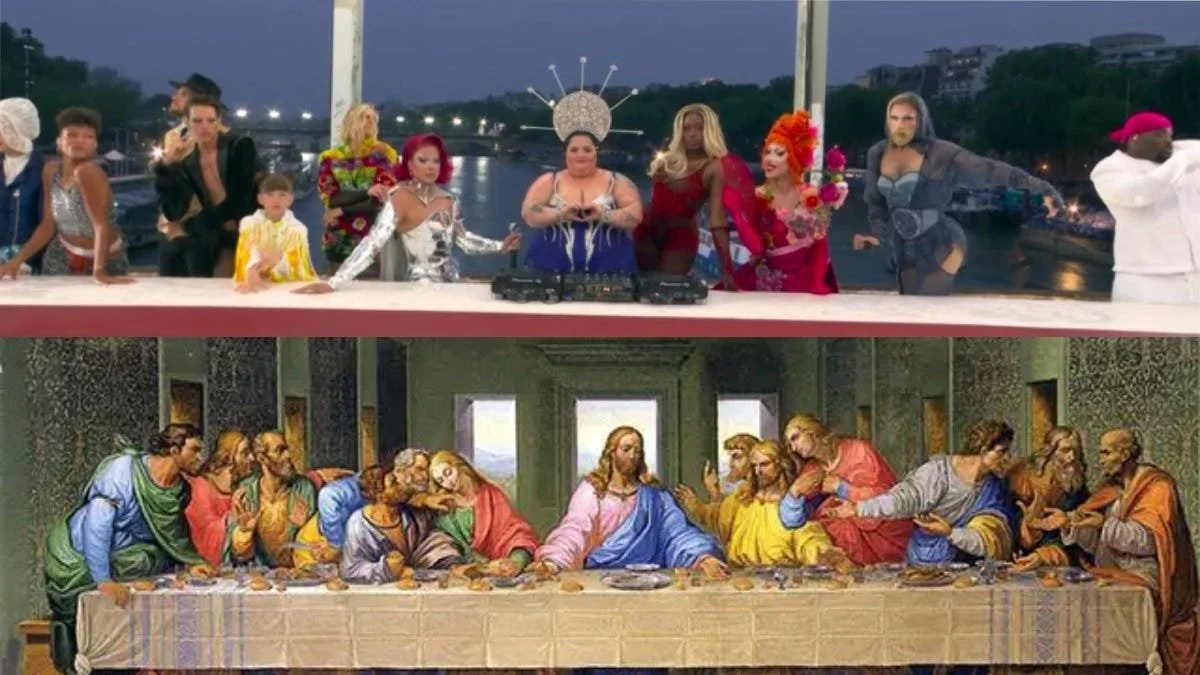
An excerpt from the 2024 Paris Olympics opening ceremony compared to the painting of The Last Supper. Image Source: Reddit
When Interpretation Eats Intention
We saw this play out recently on an international stage — when Dionysian imagery at the Paris Olympics opening ceremony was widely interpreted as a reference to The Last Supper. What was intended as a nod to Greek myth, excess, satire, and theatrical tradition was immediately flattened into offense, sacrilege, and insult.
Which is, frankly, absurd when you remember that the Olympics are Greek in origin. Honoring Greek gods at an Olympic opening ceremony is not provocation — it is continuity. And it wasn’t just Dionysus. Several Greek deities were referenced throughout the tribute, as part of a long-standing tradition of myth, symbolism, and spectacle.
But intent stopped mattering the moment interpretation took over.
France, of all places, is known for this kind of line-stepping. Blasphemy, satire, aesthetic confrontation — these are not accidents of French culture, they are features of it. France has always operated this way. That’s the lineage. That’s the point.
And yet, even that context wasn’t allowed to stand.
Once something reads as offensive, explanation becomes irrelevant. History doesn’t matter. Cultural specificity doesn’t matter. Artistic lineage doesn’t matter. All that matters is how it landed for the most offended viewer.
That’s the shift.
Art is no longer interpreted — it’s adjudicated.
And when interpretation eats intention, shared meaning becomes impossible.
Where Does That Leave Us?
I’m not asking whether culture can be expressive without being constrictive.
It can’t.
I’m not asking whether representation can exist without discomfort.
It can’t.
Those questions are settled.
The only question that remains — and it’s the one we keep avoiding — is whether we are capable of acknowledging pain without weaponizing it. And right now, that answer feels unresolved at best.
We’ve reached a point where pain automatically becomes authority, interpretation outweighs intention, and offense is treated as proof. In that environment, culture doesn’t expand, it hardens. Every expression becomes a test. Every silence becomes an indictment. Every explanation becomes a defense of harm.
This isn’t justice. It’s saturation.
And once we reach saturation, conversation collapses — not because people don’t care, but because the cost of engagement becomes too high.
The Part I Can’t Reconcile
I don’t feel cynical about this.
And I don’t feel afraid.
I just don’t feel hopeful.
And that’s new for me.
I’ve always believed in leading with love, generosity, and good faith — in relationships, in community, in culture. I’ve believed that care could bridge difference, that intention mattered, that listening could still make room for repair.
But like most relationships, love on its own isn’t enough.
Not when every interaction feels like a verdict instead of an exchange.
Not when people approach culture already braced for harm.
Not when the work of understanding is treated as optional.
Love without effort is just sentiment.
I asked more than twenty of my elders, superiors, and family members — people who raised me directly and indirectly — a question that does not have an easy or obvious answer: How do I live in the world where no one seems interested in understanding one another? I asked sincerely, and assuming wisdom would surface somewhere. What I received was the same response every time. Not disagreement. Not reassurance. Only the absence of an answer. Translation? “You’re on your own, kid.”
I understand that this isn’t a simple question. But for people who choose to bring other human beings into existence, it feels like one they should have to sit with.
So I’m left with a quieter grief: not that the world is irredeemably cruel, but that it seems increasingly uninterested in staying in the conversation long enough to fix anything.
I’m not asking for unity.
I’m not asking for agreement.
I’m asking whether we still want to live in a world where understanding is even possible.
Because right now, it feels like we don’t.
That’s the part I don’t yet know how to carry forward.
And still, when I return to the performance that sparked all of this, I understand why it moved me.
When Bad Bunny spoke to the camera, I didn’t feel like he was speaking to me, but I did feel represented. I saw someone who never gave up on himself, who believes in his home, his culture, and the value of love — not as an abstract idea, but as something lived and practiced.
He wasn’t asking anything of the audience.
Not allegiance.
Not agreement.
He just wanted us to dance with him and to love each other, if only for a moment.
That may not be enough to fix the world. But, I hope it reminds you why you still care.