Short Plays Build Strong Community at Sapphest NYC
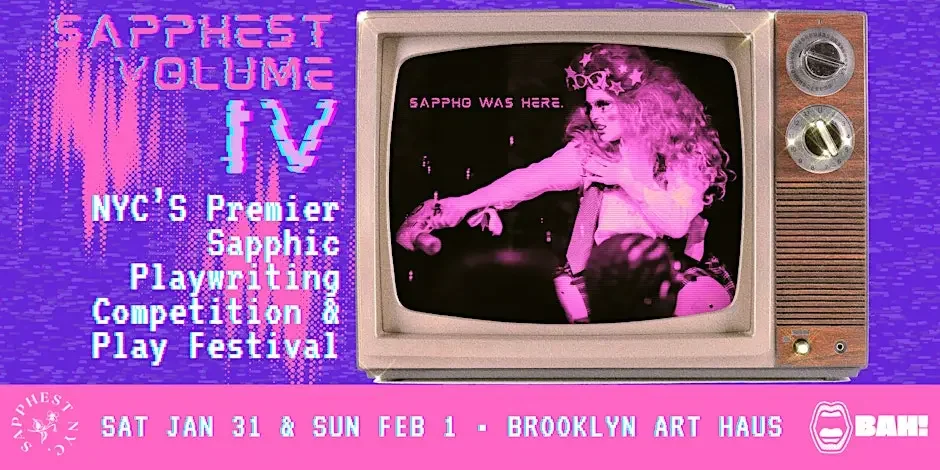
A year and a half ago, Marena Faye had an idea: a festival of sapphic ten-minute plays, inspired by sapphic songs. This week, the fourth edition of Sapphest will go up at Brooklyn Art Haus. As of writing, the originally planned Saturday evening and Sunday matinee have sold out, with a third performance added on Sunday evening.
Marena Faye, founding producer and artistic director, is still surprised by how quickly Sapphest has grown: “This is something I made up in my head while I was watching Lempicka, and now we’re doing it for a fourth time. Pretty much everything we’ve done has sold out.”
The team has grown as the festival has expanded. Marena Faye started with friend and artistic advisor Mary Kamitaki, and quickly added technical director Maggie Dunn and graphics designer and operations support Alexa Powell through Instagram and newsletter listings.
“It really was a stars aligning kind of moment,” said Powell, “I fully didn’t know any of these people before, and now they’re some of my favorite collaborators.”
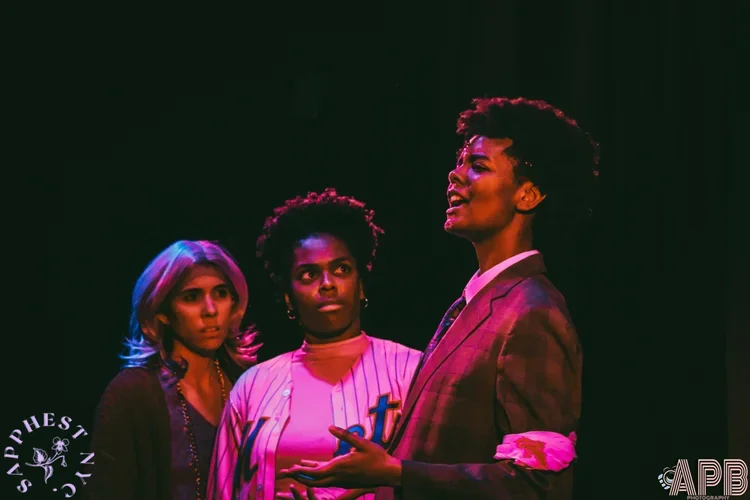
Photo by APB Photography
Director Maryanne Kiley also heard about Sapphest on Instagram. She said the community at Sapphest is what makes it special: “I feel like because this is a sapphic space, I’m not looking over my shoulder asking myself if people are laughing with or laughing at. There’s a mutual understanding and respect that makes it feel freer.”
Kathryn O’Connell, who acted in Sapphest III and has written a play for volume IV, agreed with Kiley. “The only work I’ve been able to do where I portray a queer character of some kind was something I sought out myself. That's very much what this festival is. It's people really being excited about being able to tell our own stories, telling it the way that we want to tell it, in an entirely sapphic environment.”
“I feel like because this is a sapphic space, I’m not looking over my shoulder asking myself if people are laughing with or laughing at. There’s a mutual understanding and respect that makes it feel freer.”
- Director Maryanne Kiley
In addition to the freedom of creating art in a sapphic space, everyone involved emphasized the talent that exists at all levels of Sapphest. Kamitaki, who supports the script reading process, said, “We are choosing really good plays, but the plays we don’t choose are no less good. We’re really trying to craft a diverse and interesting collection. So we are forced to say no to so many super excellent little short plays that we would love to do.”
Antonia Cruz Kent has been a reader and playwright for previous editions, and now serves as Sapphest’s resident dramaturg. She emphasized how seriously everyone involved takes the work: “No one is taking it for granted. There's a uniform understanding of this being a sacred space, and there's a silent understanding that we're all going to uphold this, that we need this sapphic space. In a city that's as big and as diverse, and as fast paced, and incredible as New York, the fact that this is one of the only sapphic theater spaces I think everyone feels that. I think there's a real effort to uphold, maintain, uplift, and keep on pulling everybody in.”
According to Kiley, the sense of community is a key part of making the art as strong as it is. “When there isn’t that layer of wondering if people are laughing for the wrong reasons, there’s a relaxation that can come, and as an artist you can take new risks.”
Since the first volume, Sapphest has been willing to try new, inventive things. Dunn, who has provided technical support for all the plays since the first edition of Sapphest, told me about The Big Pick, a play from the first edition of Sapphest that centered a pickleball game to the Challengers soundtrack. “They didn't actually have a ball, of course. So they were hitting it back and forth, then I was adding the sound effect of the ball hitting. I love when tech gets super nitpicky and exact.”
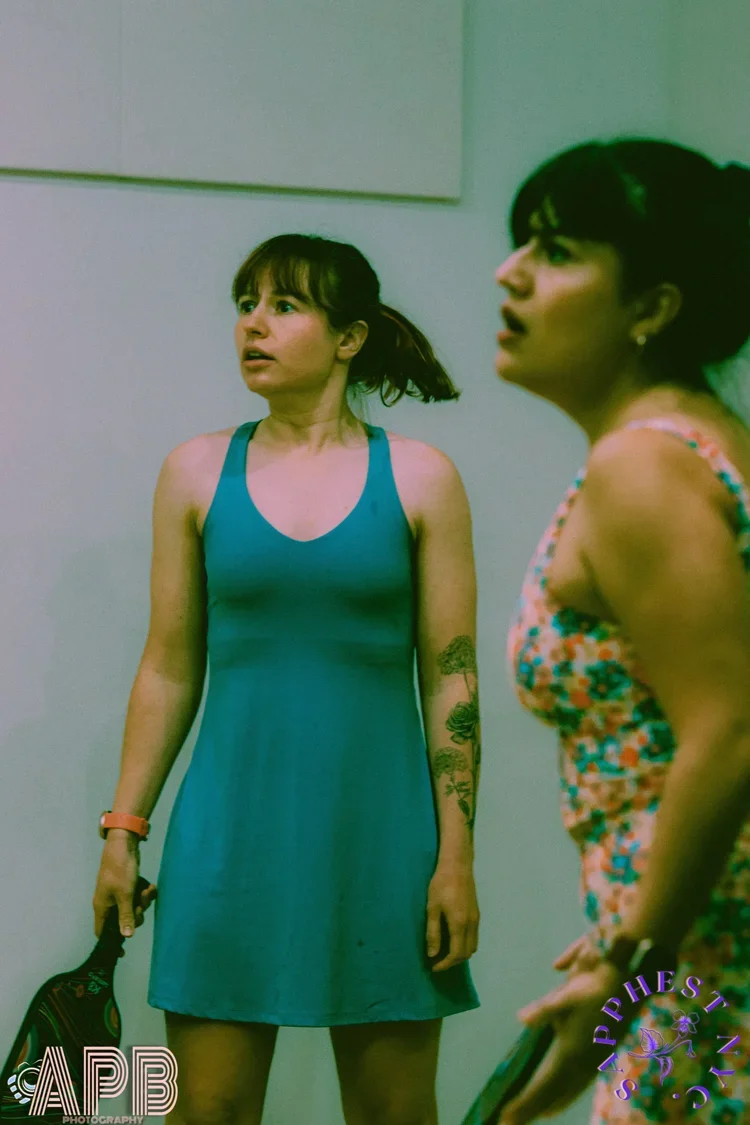
Photo by APB Photography
Ashil Lee, who directed The Big Pick, is back for volume four with another big technical element: puppets. They are directing Eating Het Wedding Cake (From the Bridesmaid’s Bouquet) which they described as, “a wonderfully clowny play about gay panic at a wedding and the breaking point of the protagonist’s self denial.” The play only uses four actors to show an entire wedding, so puppets have been the solution. Like every Sapphest piece, Eating Het Wedding Cake is about more than the fun of the process. Lee described the play’s importance: “It’s a loving look back on those younger versions of ourselves, with a little bit of friendly poking and prodding, in a way that is very knowing. And it comes from a place of love.”
“It’s a loving look back on those younger versions of ourselves, with a little bit of friendly poking and prodding, in a way that is very knowing. And it comes from a place of love.”
- Director Ashil Lee
Sapphest has no paid marketing, yet continues to grow and pay all of the participating artists, which few projects of this scale achieve. Kamitaki emphasized the power of people in making Sapphest happen: “It’s so grassroots. From the outside looking in, it’s easy to look at an arts organization and think it requires funding, expertise, credentials, or whatever. My big takeaway from Sapphest is how much is achievable, how big you can grow something, just from having a few dedicated, excited people.”
In addition to the festivals, Sapphest hosts a variety of events centered on queer artists that act as fundraisers. They’ve hosted sapphic writers’ circles, drag shows, and trivia. In a Salon Avec Moi exclusive, Marena Faye shared that Sapphest plans to host a sapphic strip club event this year, in addition to Sapphest V this summer. The team has big dreams about what Sapphest could become. Ultimately, everyone involved wants to keep filling voids in the sapphic arts scene. Marena Faye said, “My hope is that Sapphest helps to bring the community together and shows folks that sapphic art is really beautiful and important.”
Writer: Pallas M. Gutierrez
Editor-in-Chief: Karlye Whitt